

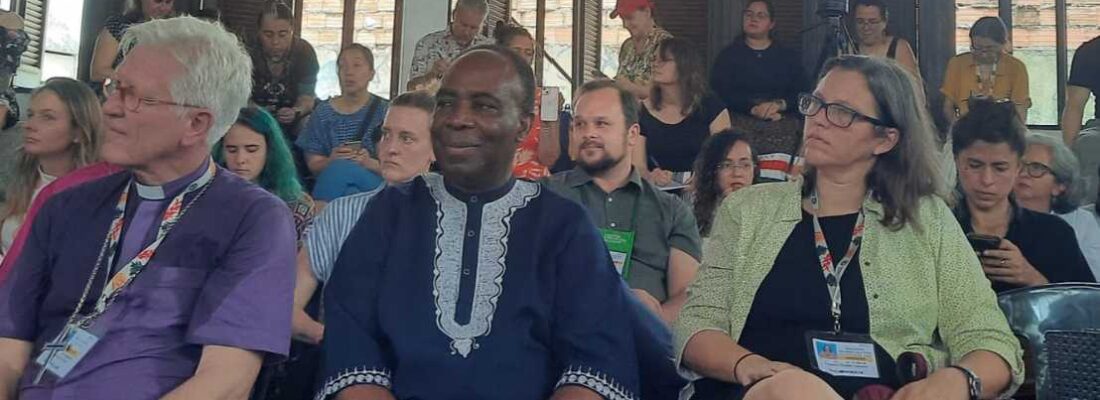
The World Council of Churches (WCC) co-convened the Interfaith Gathering in the Spirit of Talanoa Dialogue on 10 November at the Lutheran Church in Belém. Faith leaders from multiple traditions met to coordinate their advocacy for climate justice throughout COP30, the UN’s annual climate conference.
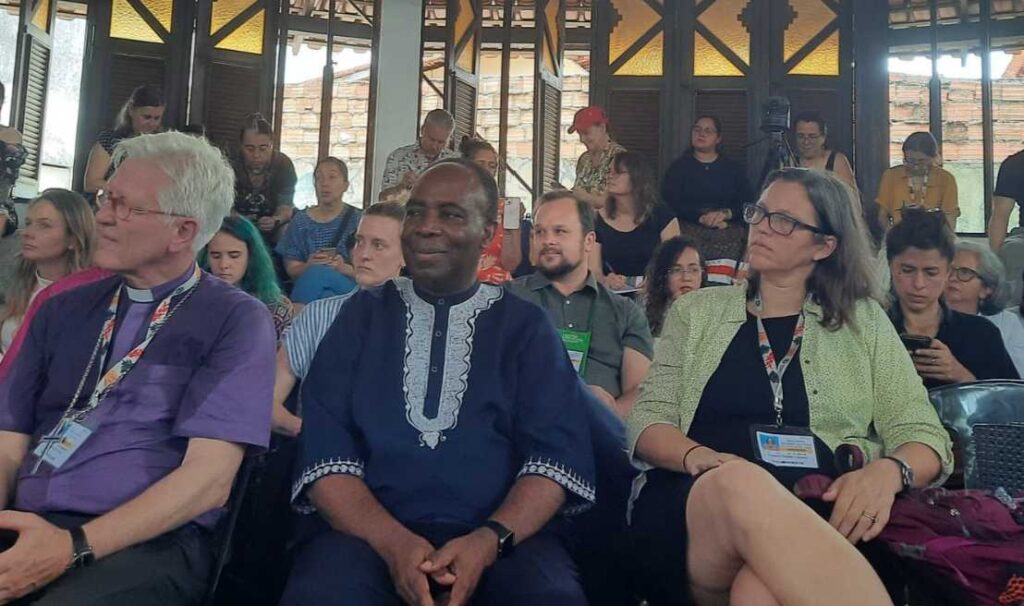
The three-hour hybrid event included a panel on how faith communities can help rebuild trust and cooperation across nations, sectors, and generations – and how to move from ethical reflection to ethical action.
Rev. Romeu Martini from the Evangelical Church of the Lutheran Confession in Brazil, welcomed the participants, followed by a panel that brought together WCC central committee moderator Bishop Prof. Dr Heinrich Bedford-Strohm, Lindsey Fielder Cook from the Quaker United Nations Office, and Nonie Reaño from Brahma Kumaris.
Bedford-Strohm explained the ethical and theological foundations of climate justice action and recalled that the WCC central committee launched the Ecumenical Decade of Climate Justice Action in June. “We are promoting climate justice action, because we firmly believe these are not only political questions; they are inseparably linked to our faith in God the Creator, in Christ, and in the Holy Spirit,” he said. “When we say God created us, we also affirm that God created us together with nonhuman creation. That gives us a sister- and brother-relationship with the whole of nonhuman creation.”
He also explained why storytelling matters in climate advocacy. “We must tell the stories of the people we met – our brothers and sisters, including Indigenous Peoples – who have shared how they are often the first victims of climate change, despite having contributed the least to it.”
After the panel, participants split into small Talanoa discussion groups in English, Spanish, and Portuguese, reflecting on the questions: Where are we now? Where do we want to go? And how do we get there? In these discussions, people of faith shared their initiatives, concerns, and hopes—connecting their faith to climate action and keeping vulnerable communities at the centre. The Talanoa methodology, rooted in Fijian Indigenous practices, uses storytelling and collaborative reflection rather than debate to build understanding and find common ground.
The gathering closed with an interfaith spiritual moment and a shared meal for in-person attendees, demonstrating how faith traditions build community around climate advocacy.
Over the next two weeks at COP30, faith communities will continue their ethical dialogue and advocacy through several events: an Interfaith Vigil on 13 November at the Anglican Cathedral, an Ecumenical Service on 16 November, and coordinated work on key negotiation points including climate finance, adaptation, and Indigenous rights.
COP30 is a critical moment for global climate action. It takes place in the Amazon region for the first time. The conference focuses on implementing the outcomes of the first Global Stocktake, preparing more ambitious Nationally Determined Contributions for 2025, and advancing the Global Goal on Adaptation. For faith communities, COP30 is a chance to show how teachings from different spiritual traditions can rebuild the trust and cooperation needed for real climate action.
No Comments
Sorry, the comment form is closed at this time.